Library Workshop Review: Zoetrope
Updated: Jul 26
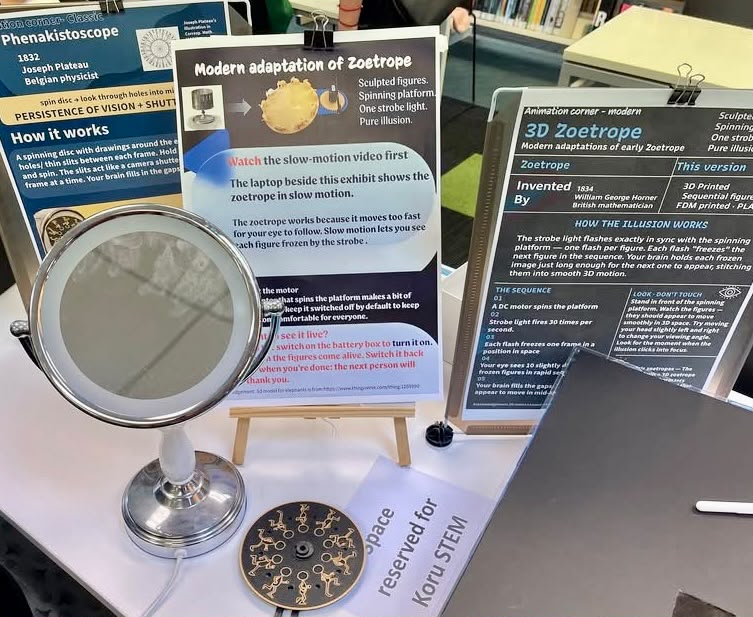
Our April 2026 Library Workshop combined history, art, physics, and engineering as participants journeyed back to the early days of animation. Before movies, television, and computer-generated imagery (CGI), inventors used devices such as the Zoetrope—often called the “Wheel of Life”—to create the illusion of movement from a series of still images. During the workshop, participants designed their own animation strips, assembled a working zoetrope, and watched their drawings come to life as the wheel began to spin. Through this hands-on experience, they discovered how early inventors transformed simple drawings into moving images and gained a deeper appreciation of the scientific principles that laid the foundation for modern animation.
How the Zoetrope Works
The zoetrope works by displaying a sequence of slightly different drawings through narrow viewing slits while the cylinder rotates. As the images pass rapidly in front of the viewer’s eyes, the brain blends them together into a continuous motion. This demonstrates the principle of persistence of vision, where an image remains on the retina for a fraction of a second after it disappears, allowing separate images to appear as a moving animation.
Through this project, participants explored several important STEM concepts:
Optics – how the eye and brain process rapidly changing images.
Persistence of vision – the scientific principle behind early animation.
Rotational motion – how spinning the cylinder creates the animation effect.
Frame-by-frame animation – understanding how modern animation is built from individual images.
Engineering design – assembling and balancing the rotating structure.
Preparation Challenge
One of the main challenges during preparation was ensuring that the zoetrope rotated smoothly without wobbling. During testing, we found that even small differences in the alignment of the cylinder and base could affect the animation quality. After several trial builds, the team refined the assembly process and prepared alignment guides so that participants could achieve a clearer and more stable animation effect.
On the Day
The workshop attracted strong interest from the community, with every available place taken. Participants were highly engaged throughout the session, especially when drawing their animation frames and testing their completed zoetrope for the first time. They enthusiastically shared ideas for animated characters, compared motion effects, and helped one another adjust their animation strips to achieve smoother movement.
Participant Feedback
Year 3 participant said “I loved seeing my drawing start to move when the wheel spun. It felt like making my own cartoon!”
Year 4 participant said “I learned that animation is made from lots of separate pictures. The zoetrope helped me understand how movies create movement from still images.”